The psychology behind a successful exhibition stand
On a busy exhibition floor, everything revolves around attention.
Visitors are constantly exposed to stimuli, brands, and stands all competing for the same goal: to stand out and start conversations. Yet only a small number of exhibitors actually succeed in doing so. Most stands are glanced at briefly, or worse, completely ignored.
The difference rarely lies in design or budget alone. It lies in how well a stand responds to human behavior.
A successful exhibition stand is not just a construction project, it’s a strategic tool designed to influence behavior. In this article, we explore the psychological principles that make the difference.
You only have a few seconds
At a busy trade show, visitors make decisions in an instant. They scan their surroundings, process visual input, and decide within seconds whether something is worth their attention.
Insights from the Nielsen Norman Group show that people first scan before they focus. This means your stand needs to be clear at a glance not just visually appealing, but immediately understandable.
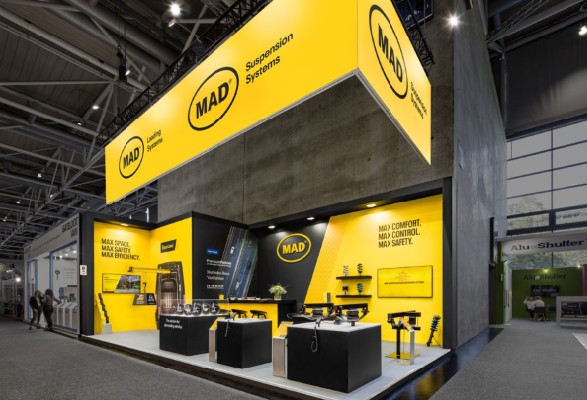
If a visitor has to think about what they are seeing, you’ve likely already lost them. Clear communication and a strong visual hierarchy ensure that visitors instantly understand what your stand is about and whether it’s relevant to them.
Too much information works against you
A common mistake is trying to communicate everything at once. Products, services, USPs all packed into one space. The result is often a stand that feels cluttered and overwhelming.
The concept of cognitive load, introduced by John Sweller, shows that people can only process a limited amount of information at a time. On a busy exhibition floor, where stimuli are everywhere, that limit is reached even faster.
This is exactly why simplicity is so powerful. A stand that feels calm and communicates one clear message makes it easier for visitors to understand what you offer. And what is easy to understand invites interaction.
Relevance drives action
Capturing attention is one thing, relevance determines whether someone actually stops.
People are more likely to engage with information that connects to their own situation. This means your stand shouldn’t just stand out, it should clearly communicate: this is for you.
The faster a visitor recognizes themselves in your message, the more likely they are to take a step closer.
This requires focus. Not trying to appeal to everyone, but targeting the right audience. Not saying everything, but communicating exactly what matters.
Behavior attracts behavior
At every trade show, you’ll notice the same pattern: busy stands attract even more visitors.
This is driven by the principle of social proof, widely described by Robert Cialdini. People are influenced by the behavior of others. When a stand is visibly active with conversations, demos, or interaction it lowers the threshold for others to join.
An empty stand has the opposite effect. Even the best design cannot fully compensate for a lack of activity. In an environment full of choices, people look for cues from others.
That’s why activity is not a detail, it’s a key driver of success.
Interaction creates impact
People remember what they do more than what they see.
Within Cognitive Psychology, it has been widely shown that active engagement leads to stronger memory retention. This is clearly visible on the exhibition floor.
A stand where something happens, where visitors can experience, test, or engage leaves a lasting impression. Not just because it’s interesting, but because it becomes an experience.
A purely visual stand may look impressive, but without interaction, its impact remains limited.
Emotion drives memory
Although trade shows are business-driven, decisions are rarely purely rational. Emotion plays a key role in attention, interest, and memory.
A stand that sparks curiosity, surprises, or inspires will always make a stronger impression than one that simply presents information. This doesn’t have to be complex it’s about the feeling you create.
That emotional layer is what ensures visitors remember your brand long after the event is over.
Conclusion: design is just the beginning
A successful exhibition stand is not a coincidence, nor a collection of separate elements.
It is the result of a strategic approach where design, psychology, and execution come together. Capturing attention, creating relevance, stimulating interaction, and evoking emotion these are the factors that determine whether a stand performs.
At Eldee, we design and build exhibition stands that don’t just look strong they deliver results. Stands that don’t just attract attention, but drive real impact.
Ready for the exhibition floor of 2026
The trade show industry continues to evolve. Companies that want to stand out need to look beyond simply creating an attractive stand design. Experience, technology, sustainability, and a strong message all play a role in the success of a trade show participation.
By combining these elements, a stand can do more than just attract attention it can actively contribute to achieving marketing and sales goals.
Are you considering participating in a trade show in 2026? Proper preparation and a clear exhibition strategy can help you get the most out of your participation.
Request a non-binding exhibition stand quotation and discover the possibilities for your next trade show participation.
Curious how we translate your specific wishes into a stand design? Make an appointment.